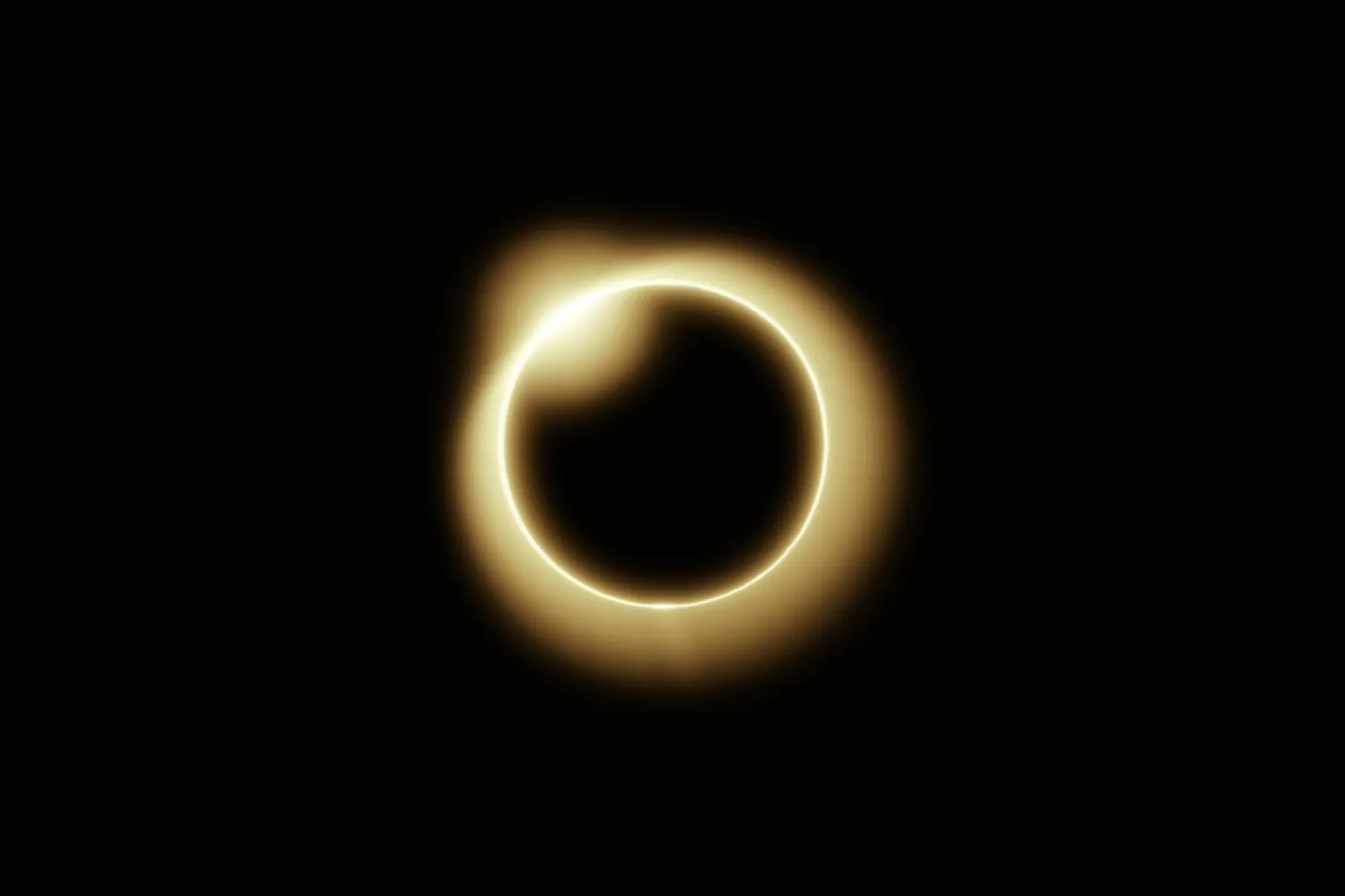
Almost six months before the total eclipse of 2 August, the year opens with an annular eclipse on Saturday 6 February 2027. NASA lists it among the coming solar eclipses, and its narrow path crosses southern Chile, Argentina and Uruguay, runs over the South Atlantic and ends at sunset in West Africa. On the day the Moon is too far from the Earth to hide the whole Sun, so a ring of sunlight stays around its edge.
Argentina has the best of it. By our calculation, the ring lasts 7 minutes 30 seconds at Las Grutas on the San Matías Gulf, starting at 12:05 local time, and 7 minutes 33 seconds at Mar del Plata, from 12:24 with the Sun 66° high in a summer sky. Across the River Plate, Punta del Este in Uruguay gets 5 minutes 25 seconds from 12:35. Buenos Aires and Montevideo lie outside the path and see a deep partial eclipse, with 82% and 86% of the Sun covered.
In Ghana the ring arrives at the very end of the day. Accra sees it from 17:49 GMT for 5 minutes 25 seconds, but with the Sun only about 4° above the horizon, so a clear view to the west matters more than anything else.
Even at its peak an annular eclipse is never safe to watch without protection, because the ring of the Sun stays far too bright. Eclipse glasses or a solar viewer are needed for the whole event, and the sky does not get dark the way it does in totality. Anyone hoping to see both eclipses of 2027 can follow the Moon’s shadow from Patagonia in February to Spain, North Africa or Egypt in August.
Related
- Annular eclipse of 6 February 2027: map, times and places
- How to watch a solar eclipse safely
- The total eclipse of 2 August 2027
Source
- NASA Science, Future eclipses
- Space.com, Annular solar eclipse 2027: everything you need to know about the ring of fire on Feb. 6