- 11:40
First contact
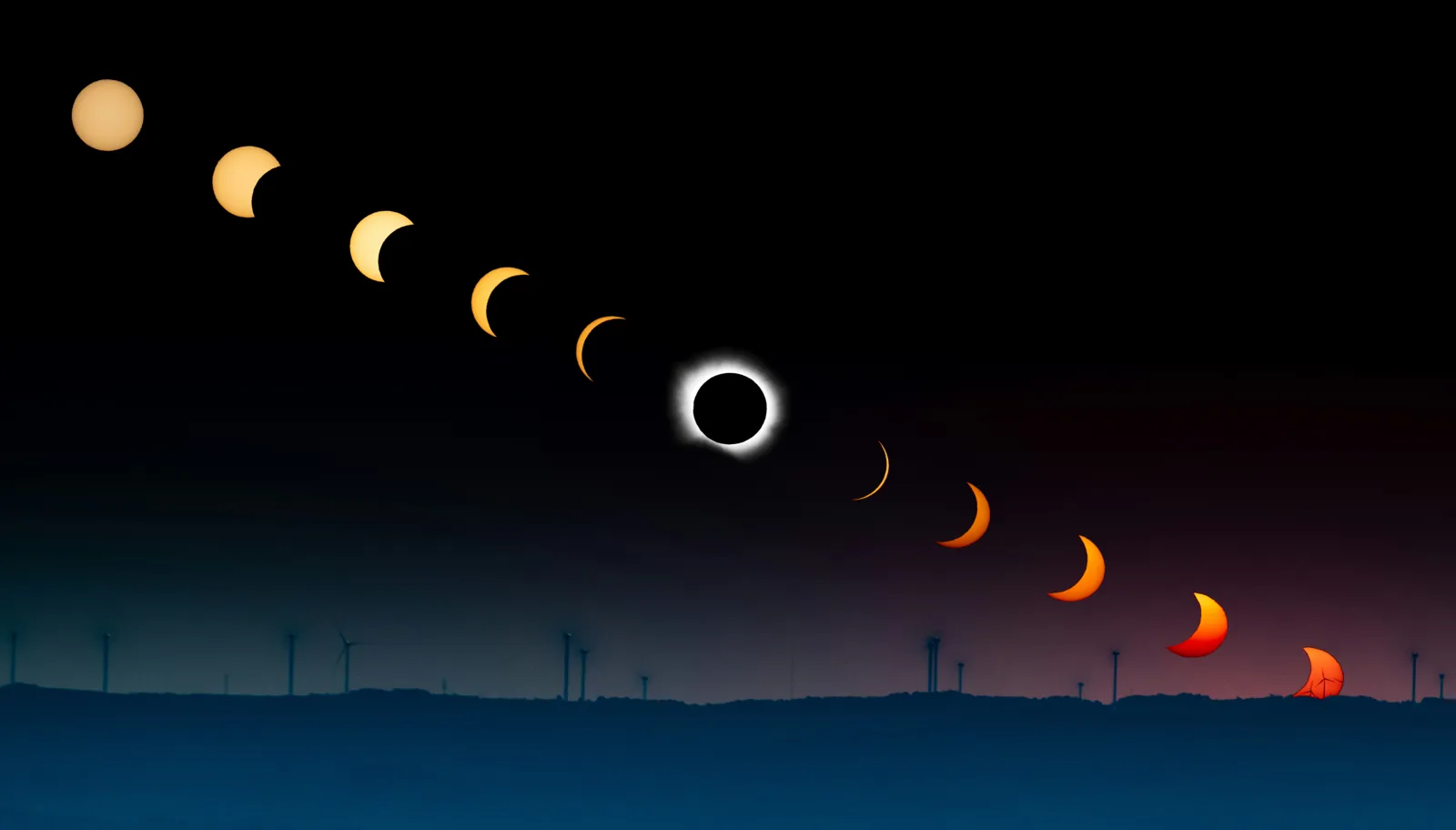
The Moon takes its first small bite out of the edge of the Sun. Nothing changes around you yet, and you need eclipse glasses to see it at all.
- 12:21 to 12:41
The light turns strange
As the Sun becomes a crescent, daylight becomes flatter and slightly metallic, even though the sky is still bright. Gaps between leaves project hundreds of small crescents onto the ground.
- 12:46 to 12:56
It gets cooler and darker
The temperature starts to drop noticeably, shadows become unusually sharp, and birds and animals may behave as if evening is coming. Venus can appear in the darkening sky shortly before totality.
- 12:59
The shadow approaches
If you have a view to the west, the sky there turns dark as the Moon’s shadow rushes towards you. Faint rippling bands of light and shade, called shadow bands, sometimes race across pale ground.
- Seconds before 13:01:55
Baily’s beads and the diamond ring
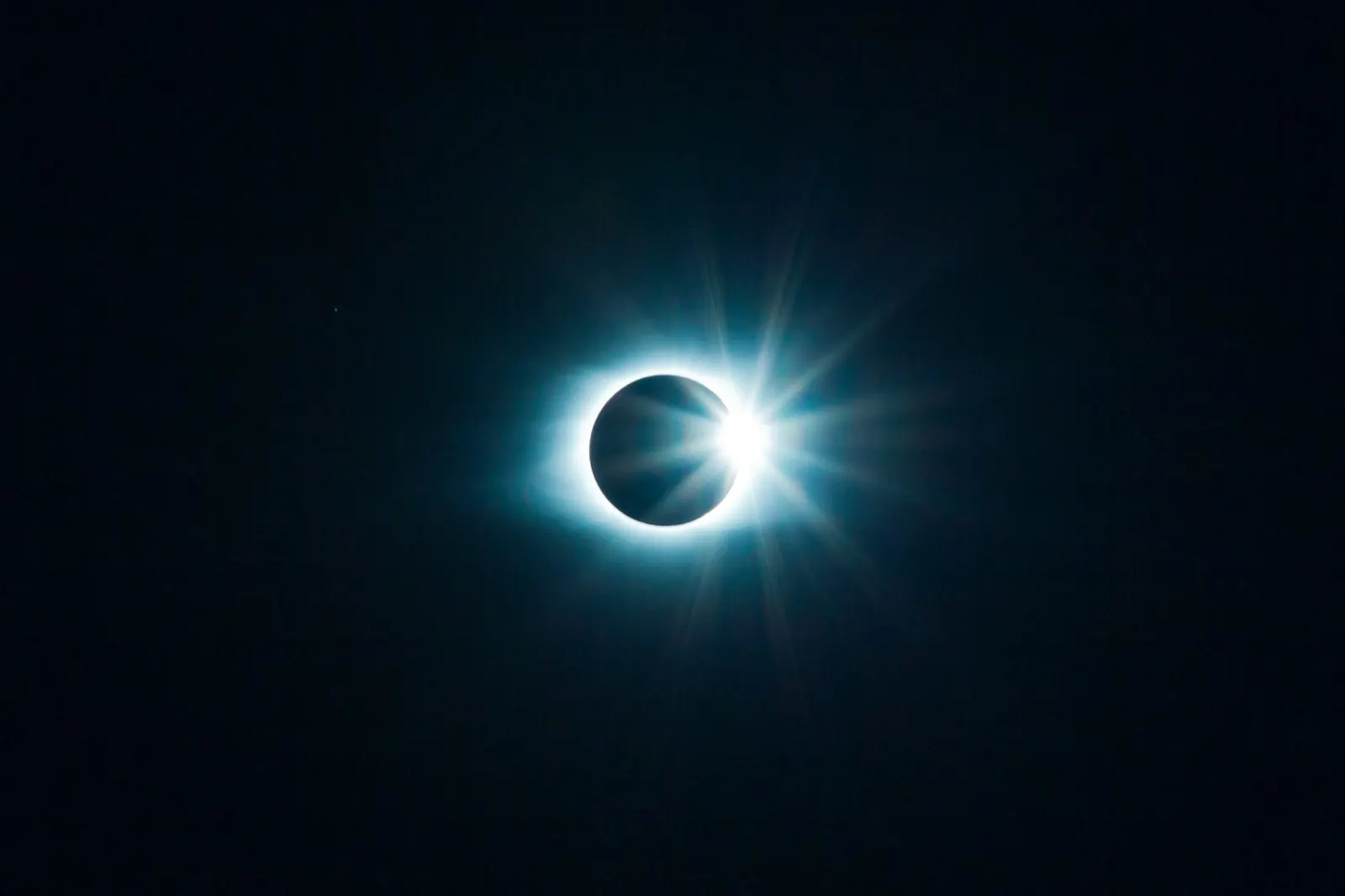
The last sunlight shines through valleys on the edge of the Moon as a string of bright beads, named after the astronomer Francis Baily. The final bead flares as a single brilliant point next to the first glimpse of the corona: the diamond ring.
- 13:01:55 to 13:08:20
Totality
For 6m 25s the Sun is completely hidden. Now, and only now, it is safe to take off your glasses and look. The corona spreads out around the black Moon, pink prominences may show at its edge, and there is a sunset glow all the way round the horizon.
- 13:08:20
Totality ends
A second diamond ring appears on the opposite side of the Moon as sunlight returns. Put your eclipse glasses back on immediately.
- 14:26
Last contact
Over the next hour or so the events run in reverse, until the Moon leaves the Sun’s disc and the eclipse ends.
Times are local time in Luxor (UTC+3), calculated for the city centre. The descriptions of light, temperature and animal behaviour are typical, and vary with weather and location.
How dark it gets, and what appears in the sky
Totality is not as dark as night. Overhead the sky turns a deep evening blue, while all around the horizon runs an orange band like a sunset seen in every direction at once. The glow comes from places outside the Moon’s shadow, about a hundred kilometres away or more, where the Sun is still shining.
In the darker sky the brightest planets come out first. A finger held at arm’s length covers about 2 degrees of sky and a fist about 10, which makes them easy to find. Over Luxor at mid-totality on 2 August 2027, by our calculation:
- Venus3° from the Sun, about a finger and a half away
- Mercury10° from the Sun, about one fist away
- Jupiter22° from the Sun, about two fists away
- Mars61° from the Sun, about six fists away
Venus is the brightest of them, so it is usually the first to show, often in the last seconds before totality, even though it sits only 3° from the Sun.
How much colder it gets
As the Moon cuts off the sunlight, the air cools quickly. During the 2017 eclipse in the United States, sunlight at the ground fell from about 800 watts per square metre to zero, and the air in Hopkinsville, Kentucky, cooled by about 4.4°C (8°F). In Lusaka, Zambia, in 2001 it dropped by about 8°C (14°F). The coldest moment usually comes a few minutes after totality ends, because the ground keeps losing heat for a while.
In the Nile Valley in August, totality comes in the early-afternoon heat, often above 40°C (104°F), so even a few degrees of cooling will be easy to feel.
What animals do
Animals react to totality in ways that researchers are still cataloguing. During the 2017 eclipse, scientists at Riverbanks Zoo in South Carolina saw giraffes break into a gallop and Galápagos tortoises start to mate. In 2024, keepers at Fort Worth Zoo in Texas watched Aldabra tortoises push so hard against their enclosure that they bent a door frame. Researchers now suspect that some of this is stress caused by the people around them: the cheering of a crowd at totality can be more alarming to animals than the darkness itself.
Why totality lasts longer in some places
The length of totality changes a lot from town to town, for two reasons. Along the path, the shadow moves slowest where the Sun is high, so in 2027 the afternoon towns in Egypt get far more time than the morning towns in Spain. Across the path, the centre line gets the longest totality, and the time shrinks to nothing at the edges.
- Luxor6m 25s
- Jeddah6m 03s
- Sfax5m 43s
- Oran5m 11s
- Tangier4m 54s
- Tarifa4m 41s
- Cádiz2m 54s
- Málaga1m 50s
- Ronda1m 16s
- Granada99.1% only
Totality on 2 August 2027 for each town centre, from our own calculation.
Near the edge, totality is short, yet the light show around it lasts longer. The Moon’s edge only just grazes the Sun’s, so Baily’s beads flicker for longer and the diamond ring can stretch out. Some experienced watchers choose an edge site for that reason, but for a first eclipse the centre line is the safer bet: more time, and less risk that a small error in position costs you totality.
What to do with your few minutes
Experienced eclipse watchers tell first-timers to decide in advance what they want to do during totality, and to keep it simple.
- Look up the exact second totality starts and ends for your spot, for example on the Luxor page, and set a phone alarm for about ten seconds before the end.
- During the partial phase, keep your glasses on and look for the crescents under trees and the sharpening shadows.
- About three minutes before totality, turn towards the west and watch the dark shadow come towards you.
- When the diamond ring fades, take your glasses off and spend the first minute on the corona with your own eyes.
- Then look around: the planets, the sunset glow on the horizon, the people around you.
- At the alarm, or the first bright point of sunlight, put your glasses back on.
Photographs of the corona are everywhere, but nobody can photograph what it felt like to stand there. If you only have a couple of minutes, spend them looking up and not at a phone screen.
Sources
- Science News Explores, When the Moon throws shade, weather can change
- NC State University, Mating, galloping and vocalizing: animal behavior during eclipses
- NPR, The total solar eclipse stressed animals out (2024)