Two questions decide the type
Think of the Moon’s shadow as a torch beam aimed at the Earth. Two questions are enough to tell which kind of eclipse you will get.
Does the Moon’s dark central shadow touch the Earth?
Does the Moon look bigger than the Sun that day?
Question one is about aim. Because its orbit is tilted, in some eclipse seasons the Moon only grazes the line between the Sun and the Earth, and its central shadow sails past a pole. Question two is about size: how big the Moon looks that day compared with the Sun.
Why the Moon looks bigger on some days
The Moon’s orbit is an oval, not a circle. Its distance from us swings between about 356,500 km and 406,700 km every month, and NASA says that at its closest it looks up to 14% wider than at its farthest. The Sun’s size in our sky changes too, though only by about 3%: the Earth is closest to the Sun in early January and farthest in early July.
Moon near its closestIt is slightly larger than the Sun and covers it completely.
Moon near its farthestIt is slightly smaller, so a ring of Sun stays visible.
The difference is small, but it decides everything. A large-looking Moon in front of a small-looking Sun gives a total eclipse with a long totality, which is why the long eclipses of 1955 and 1973 both fell in June, near the time of year when the Sun looks smallest. Shrink the Moon a little and you get a ring of fire instead. Our page on how a solar eclipse works shows the same idea as the length of the Moon’s shadow cone.
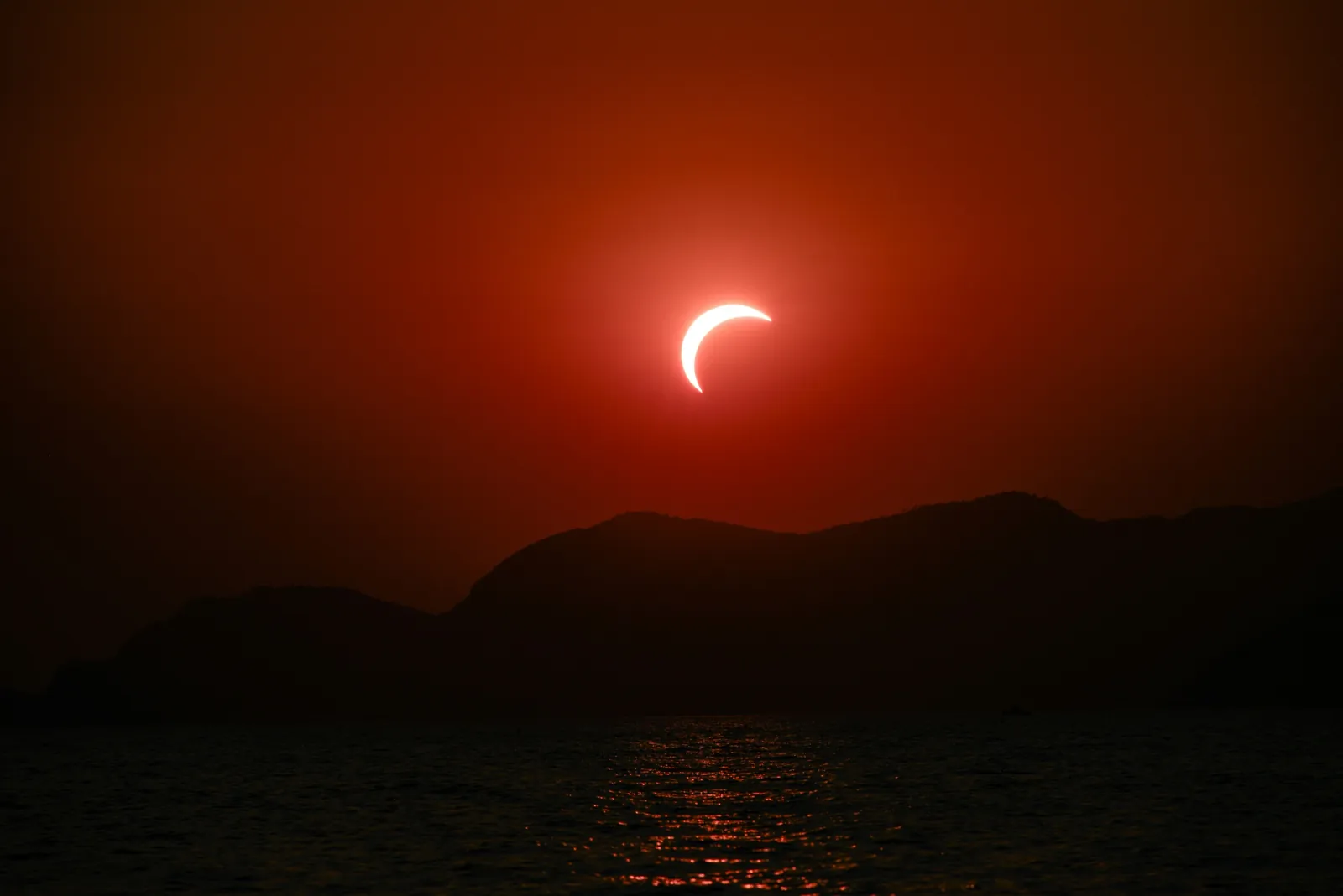
Partial eclipse: a bite out of the Sun
- What you see
- The Sun turns into a crescent, as if something had bitten into it
- Who sees it
- Everyone under the Moon’s outer shadow, an area thousands of kilometres across
- The sky
- Stays bright; the light only turns dim and flat once about 90% is covered
- Glasses
- On for the whole eclipse
- 1926 to 2025
- 82 eclipses were partial everywhere
- Next one
- 14 January 2029
A partial eclipse is the type almost everyone sees, because the Moon’s outer shadow, the penumbra, is enormous. Some eclipses are partial everywhere: the dark central shadow misses the Earth completely, and only places near one of the poles see the Moon clip the edge of the Sun. In 2029 all four solar eclipses are of this kind, including the one over North America in January.
Even a deep partial eclipse is easy to miss without glasses. With 80% of the Sun covered, daylight looks almost normal, because the remaining crescent is still dazzling. Look at the ground under a tree instead: the gaps between the leaves project hundreds of small crescents.
Total eclipse: the Sun disappears
- What you see
- A black disc surrounded by the silvery corona, with stars and planets in a dark sky
- Who sees it
- Only people inside the path of totality, usually 100 to 250 km wide
- The sky
- Deep twilight, with a sunset glow all round the horizon, for up to about 7½ minutes
- Glasses
- Off during totality only, back on at the first flash of sunlight
- 1926 to 2025
- 72 total eclipses
- Next one
- 2 August 2027
In a total eclipse the Moon covers the whole bright face of the Sun. The temperature falls, birds go quiet, and the corona, the Sun’s thin outer atmosphere, spreads out around the black Moon like silver threads. Pink flames called prominences sometimes show at its edge. You can safely look at the Sun with your bare eyes at that moment, and only then.
Totality only happens inside the narrow path of the Moon’s dark shadow, and a few kilometres outside it you get a deep partial eclipse instead. For the next one, on 2 August 2027, the path crosses southern Spain, North Africa and Arabia. The minute-by-minute guide to totality describes what to expect.
Annular eclipse: the ring of fire
- What you see
- A dark Moon inside a bright, even ring of sunlight
- Who sees it
- People inside the path of annularity; everyone else nearby sees a partial eclipse
- The sky
- Dims noticeably but never gets dark, and the corona stays hidden; the ring can last up to about 12½ minutes
- Glasses
- On for the whole eclipse, ring included
- 1926 to 2025
- 70 annular eclipses
- Next one
- 6 February 2027
An annular eclipse happens when the Moon crosses the middle of the Sun while it looks too small to cover it. A bright ring of sunlight stays visible all round its edge, which gives the eclipse its nickname. The word comes from the Latin annulus, a small ring.
The ring sounds spectacular, and it is, but it is still a slice of the Sun’s blinding surface. Daylight dims to a strange, silvery tone without ever turning dark, and you need eclipse glasses from start to finish. The next ring of fire comes on 6 February 2027, when the path crosses Chile, Argentina and Uruguay before ending at sunset over West Africa.
Hybrid eclipse: two types on one path
- What you see
- A ring of fire near the start and end of the path, a short totality in the middle
- Who sees it
- People along a single path that changes type as it crosses the Earth
- The sky
- Dark only where it is total, and only briefly: 1 minute 16 seconds at best in April 2023
- Glasses
- Off only where and while the Sun is completely covered
- How rare
- About 1 solar eclipse in 20
- Next one
- 14 November 2031
A hybrid eclipse changes type along its path. The Earth is round, so the middle of the path can be up to about 6,400 km, one Earth radius, closer to the Moon than its two ends, where the shadow arrives at sunrise and leaves at sunset. On a borderline day that small difference turns the ring of fire into a total eclipse in the middle of the path, and sometimes back into a ring near the end.
Over five thousand years, only about 4.8% of solar eclipses are hybrids. The last one, on 20 April 2023, was total over Western Australia, Timor-Leste and western New Guinea. Its successor, on 14 November 2031, is total only at sea and ends as a sunset ring of fire over Panama.
Which type is worth travelling for
On paper the three types seen from the ground look similar: the Moon covers some or all of the Sun. In the sky they are very different, and the gap between 99% and 100% is bigger than the gap between 0% and 99%.
Partial and annular eclipses are worth stepping outside for with a pair of eclipse glasses. For a total eclipse, people cross continents, and the eclipse calendar lists every one until 2045.
Our counts and calendar list hybrid eclipses under the type seen at greatest eclipse.
Good questions
- Which type of solar eclipse is the rarest?
- Hybrid eclipses. Over the 5,000 years from 2000 BCE to 3000 CE, about 4.8% of solar eclipses are hybrid, against roughly 27% total, 33% annular and 35% partial.
- Do you need glasses for an annular eclipse?
- Yes, for the whole time. Even at the peak a ring of the Sun’s surface stays uncovered, and it is bright enough to damage your eyes.
- Is a 99% partial eclipse almost the same as a total one?
- No. With 1% of the Sun left the sky is still bright, the corona is invisible and you still need glasses. Only 100% coverage brings darkness and the corona.
Sources
- NASA Science, Types of solar eclipses
- EclipseWise, Solar eclipse statistics (Five Millennium Canon)
- NASA Science, Supermoons